Base endurance running: pace, duration and benefits
Updated October 4, 2026
Easy, long and regular runs are the foundation of almost every running plan. Here is the pace to run them at and why they work.
What is base endurance?
It is the easy running pace at which your body relies mostly on oxygen (aerobic effort) and at which you can still talk while running. It corresponds to about 65–75% of your vVO2max, or 60–70% of your heart rate reserve, which is zone 2. A base endurance run is also called an easy run.
What pace should you run it at?
The simplest guide is speech: if you can no longer say a full sentence, you are going too fast. Here are the matching paces for each vVO2max.
| vVO2max | Endurance pace (65–75%) |
|---|---|
| 12 km/h | 6:40 – 7:42 /km |
| 13 km/h | 6:09 – 7:06 /km |
| 14 km/h | 5:43 – 6:36 /km |
| 15 km/h | 5:20 – 6:09 /km |
| 16 km/h | 5:00 – 5:46 /km |
| 17 km/h | 4:42 – 5:26 /km |
| 18 km/h | 4:27 – 5:08 /km |
As for heart rate: for a 35-year-old runner with a resting heart rate of 55 bpm, zone 2 runs from 132 to 145 bpm. Calculate yours. On easy runs, heart rate is a better guide than pace: heat, wind and fatigue shift your pace without changing your effort.
How long, how often?
From 40 to 90 minutes depending on your level, two to three times a week. About 80% of a plan’s volume is run at this intensity, and the remaining 20% at a harder effort (threshold, intervals). The week’s long run is also a base endurance run: only its duration changes.
Why it works
Easy, prolonged effort builds your endurance: more capillaries, more mitochondria, better running economy. Above all, it lets you build volume without wearing yourself out, so you can train consistently and then absorb the fast sessions. Without this base, intervals wear you down more than they make you progress.
Common mistakes
- Going too fast. The number one mistake: an easy run that drifts into a medium-hard effort, neither easy nor truly hard.
- Sticking to a fixed pace regardless of terrain. On a hill or in the heat, follow your breathing and heart rate.
- Neglecting recovery. An easy run should not leave you tired the next day.
Runalis is not medical advice. If you feel pain, stop and see a health professional.
In the app
The right pace, every day
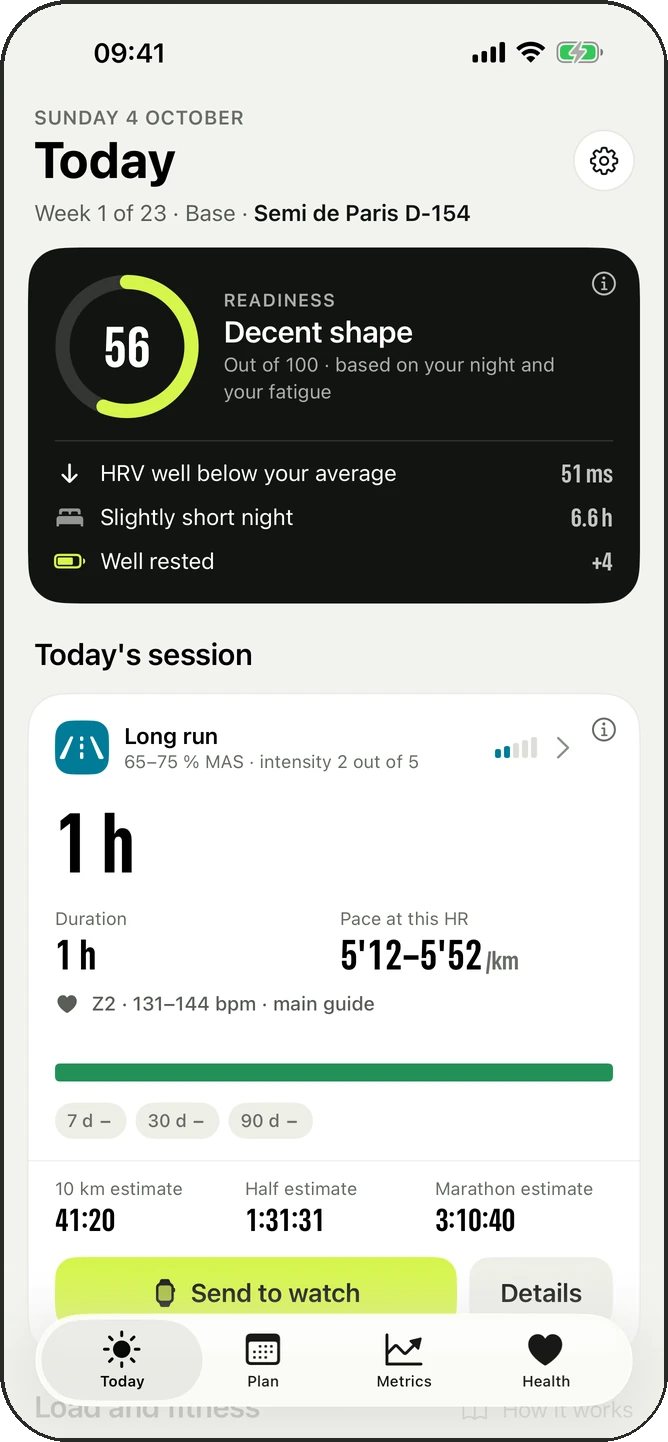
For every easy run, Runalis shows the pace, the target heart-rate zone and the reason for any adjustment.
Discover Runalis