Max heart rate and heart-rate zones calculator
Enter your age and your resting heart rate. You get your estimated maximum heart rate and your 5 training zones in beats per minute, using the Karvonen method.
Formula
 zone HR = resting HR + % × (max HR − resting HR)
 max HR = 208 − 0.7 × age (Tanaka, if you do not know it)
The zones are fractions of the heart rate reserve (max HR − resting HR): Z1 50–60%, Z2 60–70%, Z3 70–80%, Z4 80–90%, Z5 90–100%.
Source
Karvonen, 1957 (heart rate reserve); Tanaka, Monahan and Seals, 2001 (max heart rate).
Limits
The Tanaka formula is a population average: individual differences reach around ten beats. If you know your measured max heart rate, enter it. A loose chest strap or watch skews the reading.
Your 5 zones
| Zone | % of heart rate reserve | Heart rate |
|---|---|---|
| Z1 Recovery | 50–60% | 120–132 bpm |
| Z2 Endurance | 60–70% | 132–145 bpm |
| Z3 Tempo | 70–80% | 145–158 bpm |
| Z4 Threshold | 80–90% | 158–171 bpm |
| Z5 vVO2max | 90–100% | 171–184 bpm |
In the app
Your zones, calculated in the app
The app calculates your heart-rate zones with the Karvonen method from your resting and max heart rate, and keeps them up to date with your Health data.
Discover Runalis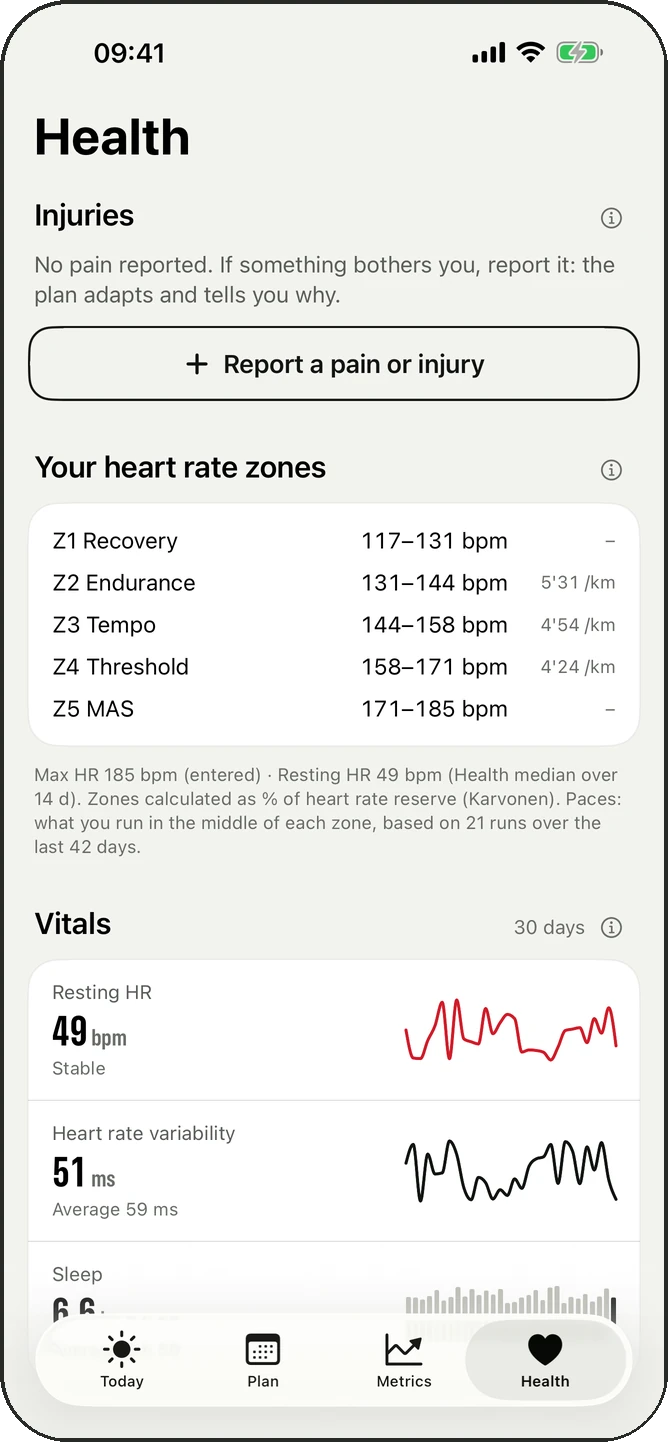
What are the zones for?
Each session in the plan targets a zone: recovery and walking in Z1, base endurance and long runs in Z2, race-specific pace in Z3–Z4, threshold in Z4, vVO2max intervals in Z5. For easy sessions, heart rate is the main reference; for fast sessions, it is pace.
Estimated max heart rate by age
The Tanaka formula compared with the old “220 − age” rule:
Common mistakes
- Using 220 − age: this old formula can be off by more than ten beats.
- Measuring resting heart rate after a coffee or a bad night.
- Trying to hold a zone during a very short effort: heart rate takes time to rise.