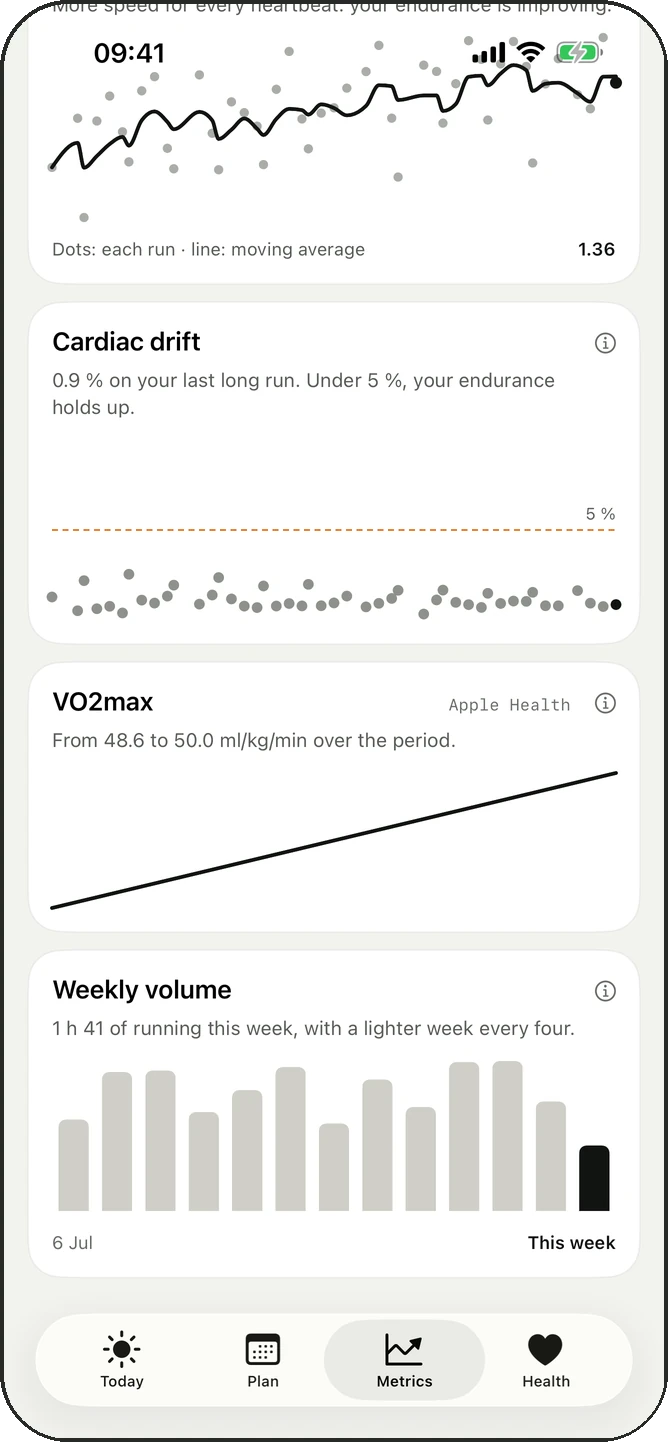
Cardiac drift (decoupling)
Updated October 3, 2026 · Source: Aerobic decoupling principle (Pa:Hr), popularized by Joe Friel
01What it is
Measures how much your heart rate climbs late in a run when your pace stays the same. A simple endurance test that Apple Health does not offer.
02How it’s calculated
Decoupling = (EF₁ − EF₂) ÷ EF₁ EF (aerobic efficiency) = speed in m/min ÷ average HR, calculated excluding the first 5 minutes.
EF₁: first half of the run. EF₂: second half.
It is calculated on steady runs of at least 30 minutes.
03How to read it
| Decoupling | Reading | What it means |
|---|---|---|
| < 5% | Solid endurance | Your endurance holds for this duration. |
| 5 – 10% | Moderate drift | Intermediate zone. |
| > 10% | Marked drift | The duration exceeds what your endurance can hold today (or heat, dehydration). |
Solid endurance< 5%
Your endurance holds for this duration.
Moderate drift5 – 10%
Intermediate zone.
Marked drift> 10%
The duration exceeds what your endurance can hold today (or heat, dehydration).
04What it’s used for
It helps you judge whether your long runs are at the right intensity.
05Limits
It only makes sense on a run at a steady pace. Heat, elevation and fatigue distort it: compare runs of the same type.
Runalis is not medical advice. If you feel pain, stop and see a health professional.