Race time predictor (VDOT)
Enter a recent result. You get your VDOT and the time you could run over 5K, 10K, half marathon and marathon.
Formula
 VDOT = O₂ cost(speed) ÷ sustainable fraction(duration)
 O₂ cost = −4.60 + 0.182258 × v + 0.000104 × v² (v in m/min)
 fraction = 0.8 + 0.1894393 · e−0.012778 t + 0.2989558 · e−0.1932605 t (t in min)
Predicted times are calculated by inverting this formula (binary search). The Riegel column gives, for comparison, the simple formula time × (distance₂ ÷ distance₁)1.06.
Source
Jack Daniels, Daniels’ Running Formula (VDOT model); Pete Riegel, 1981 (exponent 1.06). These are the same constants as in Runalis.
Limits
These are potential times: a good day, a flat course, well prepared. The marathon assumes specific training: without it, the prediction is optimistic. VDOT itself is accurate to within a few percent.
Your predicted times
| Distance | Time (Daniels) | Pace | Riegel |
|---|---|---|---|
| 5 km | 24:06 | 4:49 /km | 23:59 |
| 10 km · your result | 50:00 | 5:00 /km | 50:00 |
| Half marathon | 1:50:52 | 5:15 /km | 1:50:19 |
| Marathon | 3:49:34 | 5:26 /km | 3:50:01 |
The marathon assumes long runs and weekly volume: the projection is optimistic without that preparation.
In the app
Your projections, kept up to date in the app
Runalis projects your times over 10K, half marathon and marathon from your fitness level, and tracks how they change over 7, 30 and 90 days.
Discover Runalis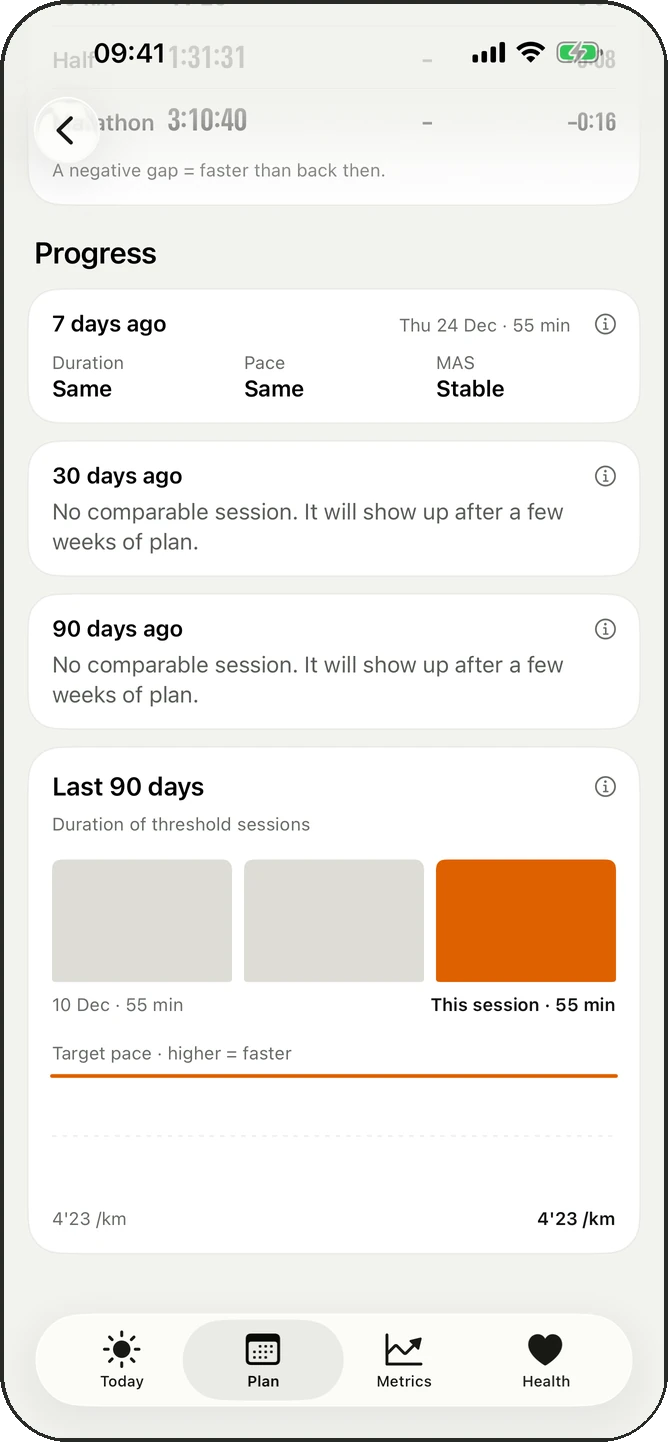
How to read the result
VDOT is a level, not a finish time: two runners with the same VDOT run consistent times over every distance. To stay realistic, enter a recent result, run all-out on a flat course.
From VDOT to vVO2max
VDOT is equivalent to your effective VO2max; the matching speed is your vVO2max: about 14.4 km/h for 45.3, 13.1 km/h for 40.0. Runalis uses this equivalence to set the pace of every session. See your paces by session.