vVO2max calculator
Pick your test and enter your result. You get your vVO2max, its margin of error and your training paces.
Formula
vVO2max = d ÷ 100
vVO2max = 1,650 ÷ 100 = 16.5 km/h
6 minutes: d is the distance covered in 6 minutes, in meters; the result is the average speed held, in km/h. Léger: stage 1 is run at 8.5 km/h and each stage adds 0.5 km/h (stage 12 = 14 km/h, stage 17 = 16.5 km/h).
Source
Principle of the 6-minute test: the average speed held over a maximal 6-minute effort approaches vVO2max. Léger test: Luc Léger’s 20 m multistage shuttle run (1982). These are field benchmarks, not laboratory measurements.
Limits
Margin of ± 0.5 km/h. Wind, slope, warm-up and pacing all change the result. The Léger test depends on how precisely you turn and on your motivation.
Your paces as a percentage of vVO2max
Here is what it would look like in a plan
A week generated from your vVO2max. In the app, it rewrites itself when your fitness changes.
See what it would look like in your planIn the app
Your vVO2max, recalculated in the app
In Runalis, every session is prescribed as a percentage of vVO2max: when your vVO2max improves, the paces follow without rebuilding the plan.
Discover Runalis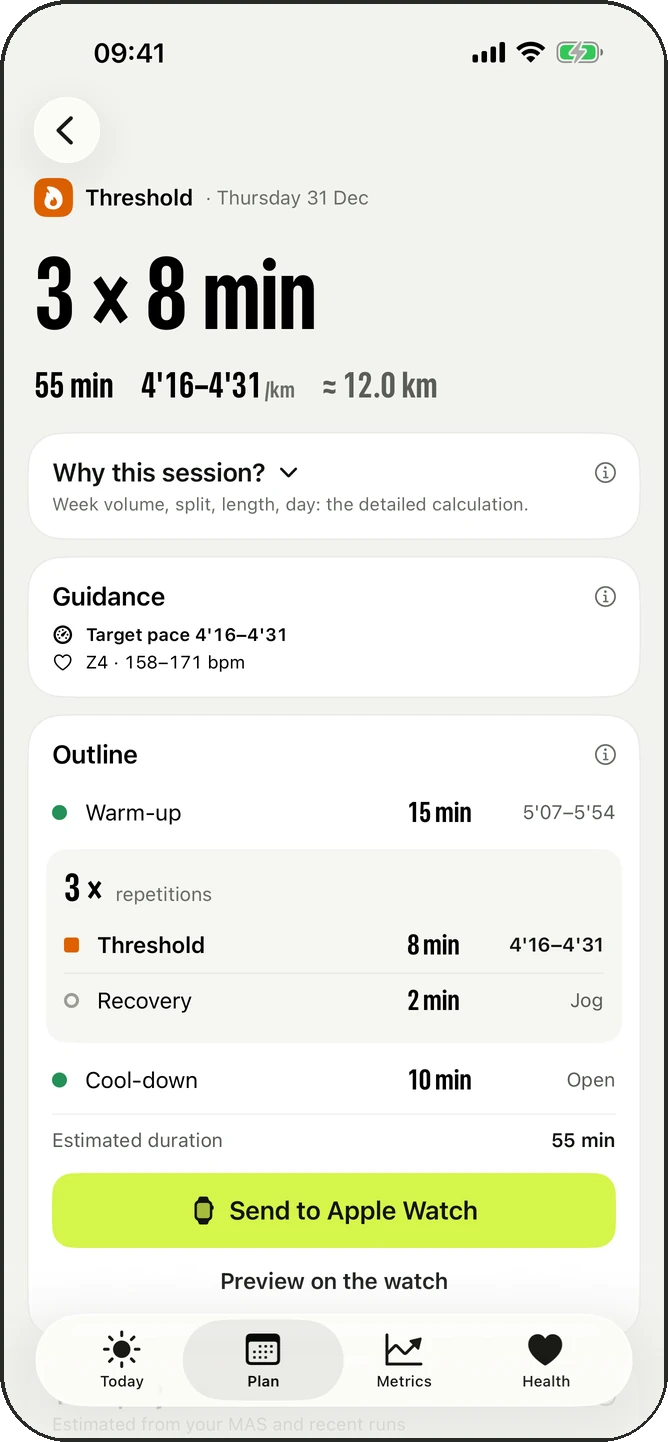
How to calculate your vVO2max
vVO2max (velocity at VO2max, also called maximal aerobic speed or MAS) is the speed at which your oxygen consumption reaches its maximum. In a lab it is measured on a treadmill with a gas analyzer. In the field, you estimate it with a test. There are three ways to do it.
1. The 6-minute test (half-Cooper)
After a 15-minute warm-up, run as far as you can in 6 minutes on a track or flat ground, at an even speed. Divide the distance in meters by 100: that is your vVO2max in km/h. With 1,650 m, your vVO2max is 16.5 km/h, or 3:38 per kilometer at 100%.
2. The 20 m shuttle run (Léger test)
You run between two lines 20 m apart, following an audio signal. Speed starts at 8.5 km/h and rises by 0.5 km/h at each stage. Your vVO2max is the speed of the last stage you held: stage 12 → 14.0 km/h, stage 17 → 16.5 km/h. It needs an audio track or an app and is done indoors or on flat ground.
3. From a recent race
No test at hand? A 5K, 10K or half marathon run all-out gives an estimate: the race time predictor (VDOT) converts your time into a fitness level and then into vVO2max. It is less precise than a dedicated test, but it takes no extra effort.
Pace chart by vVO2max
For each vVO2max, the paces of the main sessions (in minutes per kilometer) and the matching distance for the 6-minute test.
| vVO2max | 6 min | Easy run 65–75% | Threshold 85–90% | vVO2max 100% |
|---|---|---|---|---|
| 12 km/h | 1,200 m | 6:40 – 7:42 | 5:33 – 5:53 | 5:00 /km |
| 13 km/h | 1,300 m | 6:09 – 7:06 | 5:08 – 5:26 | 4:37 /km |
| 14 km/h | 1,400 m | 5:43 – 6:36 | 4:46 – 5:03 | 4:17 /km |
| 15 km/h | 1,500 m | 5:20 – 6:09 | 4:27 – 4:42 | 4:00 /km |
| 16 km/h | 1,600 m | 5:00 – 5:46 | 4:10 – 4:25 | 3:45 /km |
| 17 km/h | 1,700 m | 4:42 – 5:26 | 3:55 – 4:09 | 3:32 /km |
| 18 km/h | 1,800 m | 4:27 – 5:08 | 3:42 – 3:55 | 3:20 /km |
| 19 km/h | 1,900 m | 4:13 – 4:51 | 3:31 – 3:43 | 3:09 /km |
| 20 km/h | 2,000 m | 4:00 – 4:37 | 3:20 – 3:32 | 3:00 /km |
Common mistakes
- Starting too fast and slowing down after 3 minutes: the total distance drops.
- Running in wind or on sloping ground.
- Testing without a warm-up (allow about 15 minutes of easy running).
- Comparing a track result with a road result.