vVO2max (velocity at VO2max): definition, calculation and use
Updated October 4, 2026
vVO2max is the reference that gives every session its pace. Here is what it measures, how to find yours and how to use it.
What is vVO2max?
vVO2max (velocity at VO2max, also called maximal aerobic speed or MAS) is the lowest running speed at which your oxygen uptake reaches its maximum, your VO2max. In practice, it is the speed you can sustain for about 6 minutes flat out. It is expressed in km/h: a vVO2max of 16 km/h corresponds to a pace of 3:45 per kilometer.
Do not confuse it with top speed, the speed of a sprint lasting a few seconds, or with VO2max, which is a rate of oxygen uptake (ml/kg/min), not a speed. The two are linked: the higher your VO2max, the higher your vVO2max.
What is vVO2max used for?
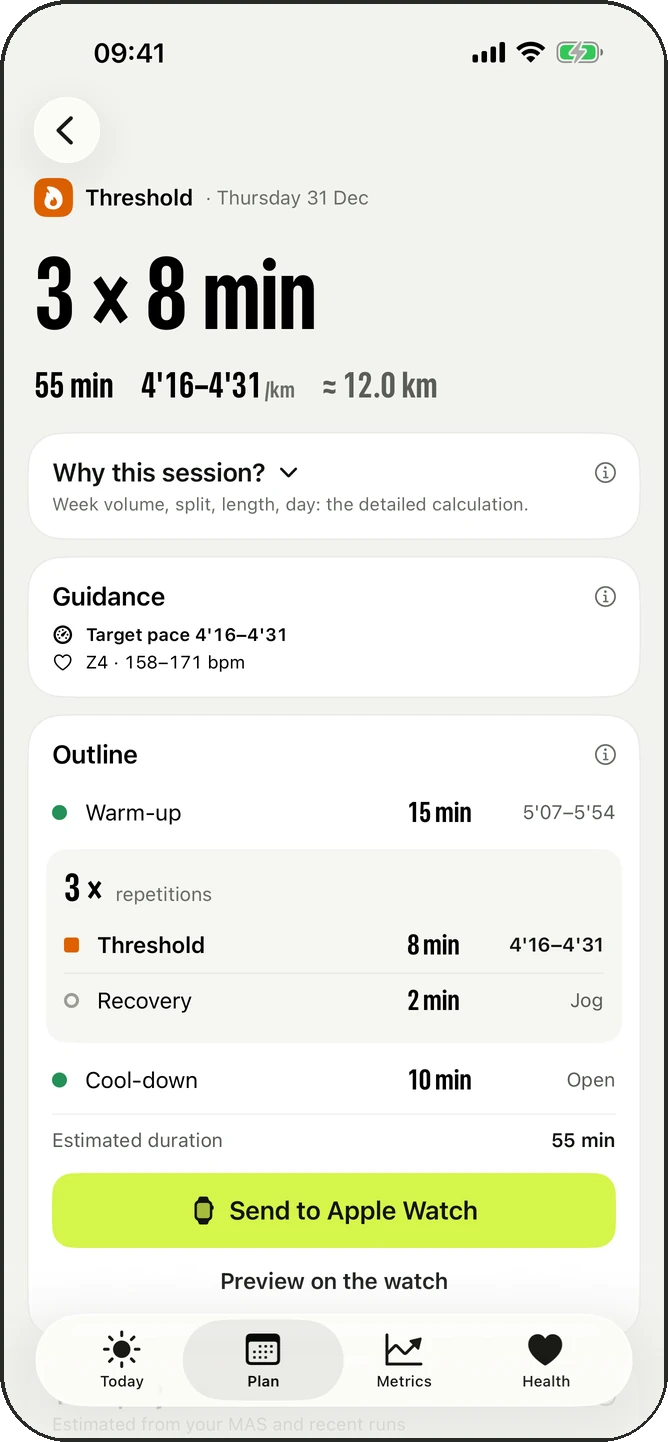
It gives a common basis for setting the intensity of every session. Instead of a fixed pace, a plan prescribes a percentage of vVO2max: when your vVO2max improves, all the paces follow without rebuilding the plan. Here are the percentages used by Runalis, with the matching paces for a vVO2max of 16 km/h.
| Session | % of vVO2max | Pace (vVO2max 16 km/h) |
|---|---|---|
| Base endurance | 65–75% | 5:00 – 5:46 /km |
| Long run | 65–75% | 5:00 – 5:46 /km |
| Threshold | 85–90% | 4:10 – 4:25 /km |
| Fartlek | 85–100% | 3:45 – 4:25 /km |
| vVO2max intervals | 95–105% | 3:34 – 3:57 /km |
| 10K race pace | 88–92% | 4:05 – 4:16 /km |
| Half marathon race pace | 84–88% | 4:16 – 4:28 /km |
| Marathon race pace | 78–84% | 4:28 – 4:48 /km |
Hill sessions are run by feel: on a slope, pace is meaningless.
How do you find your vVO2max?
Three approaches, from the most precise to the simplest:
- A field test: the 6-minute test (distance in meters ÷ 100) or the Léger shuttle test. Calculate your vVO2max with the tool.
- A recent race: a 5K, 10K or half marathon raced all-out gives an estimate through the VDOT model. Estimate it from your time.
- Your runs: Runalis estimates it continuously from your heart rate and pace. The estimate is accurate to about 3–5% and gets sharper after a few hard runs.
How do you improve your vVO2max?
vVO2max is trained with short intervals at 95–105% of vVO2max: 8 × 400 m, 6 × 3 minutes or 5 × 800 m, with 1 to 2 minutes of recovery. One session a week is enough, on top of a solid endurance base (see base endurance). A gain of 0.5 km/h over a few weeks is a good result; beyond that, progress is slower.
The limits of vVO2max
A field test gives an estimate within ±0.5 km/h: wind, elevation, warm-up and pacing all change the result. vVO2max says nothing about your endurance: two runners with the same vVO2max can hold very different paces in a marathon. It is a reference for your sessions, not a verdict on your level.
Runalis is not medical advice. If you feel pain, stop and see a health professional.
In the app
Your vVO2max, recalculated in the app
In Runalis, every session is prescribed as a percentage of vVO2max: when your vVO2max improves, the paces follow without rebuilding the plan.
Discover Runalis