Returning to running after a break or an injury
Updated October 4, 2026
Coming back too fast is the top cause of relapse. Here is the Runalis method: volume in steps, easy running first, no catching up.
Why you should come back in steps
After a break, your endurance has dropped, but your tendons and bones have lost even more of their capacity to absorb impact. If you restart at your usual volume, the load quickly exceeds what your body can handle: this is what the load ratio (ACWR) measures. A stepped return avoids that spike.
The Runalis method
- Volume in steps: 50% of your usual volume in the first week, then 65%, 80% and 90%.
- Duration: 14 days if the break lasted less than a week, 21 days for 1 to 3 weeks, 28 days beyond that.
- Easy running only for the first two weeks: no intervals, no hill repeats.
- Longest run: 75 minutes maximum during the return.
Work out your return plan
What if the pain persists?
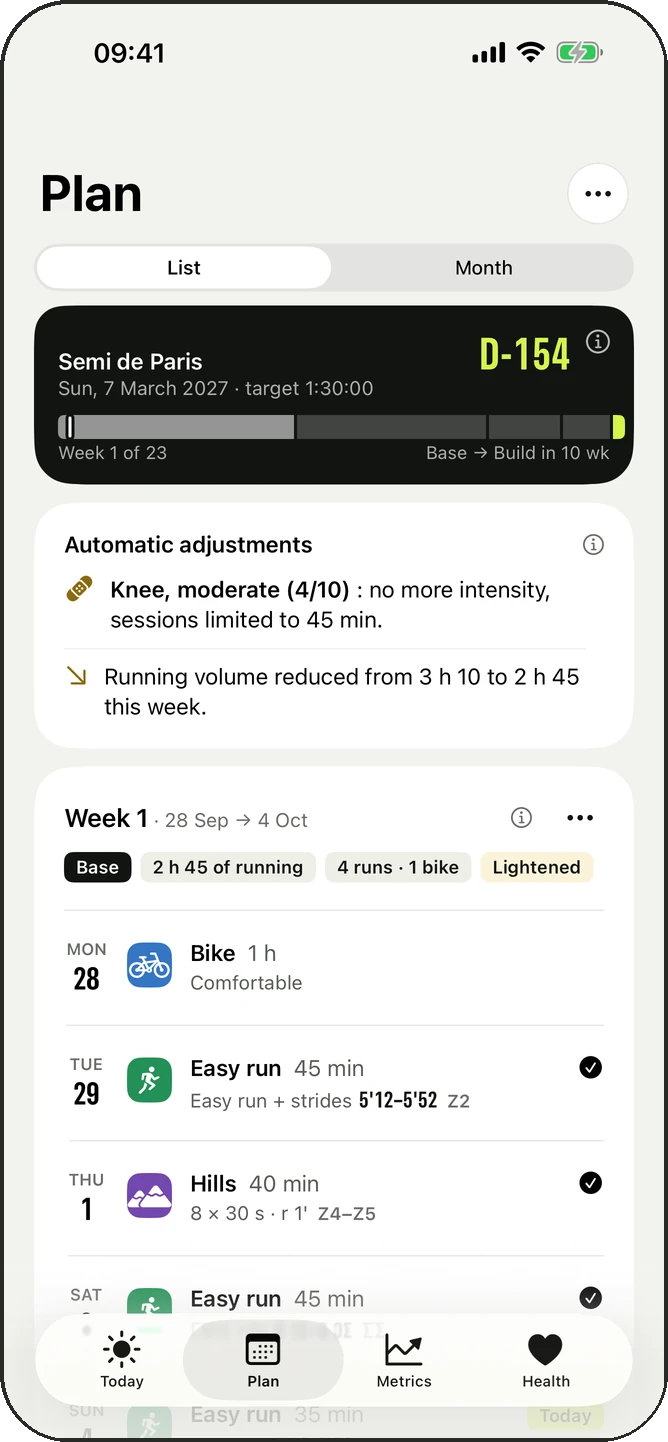
Get it checked by a health professional. Pain that comes back on every run, that grows or that changes your stride is not something to “push through”. Depending on the severity of a reported injury, Runalis replaces running with a no-impact activity, then resumes in steps once the injury has healed. It does not replace a diagnosis.
Returning after a simple break
Even without an injury (vacation, illness, a busy period), the logic is the same: build your volume back up in steps rather than all at once. The table above applies to any break, as long as you stay at base endurance pace at the start.
Runalis is not medical advice. If you feel pain, stop and see a health professional.
In the app
Your return, in the app
When you report a healed injury, Runalis builds the return in steps for you, with the reason and the original version in plain view.
Discover Runalis