Acute:Chronic Workload Ratio (ACWR)
Updated October 3, 2026 · Source: Gabbett, 2016 · exponential moving averages: Williams et al., 2017
01What it is
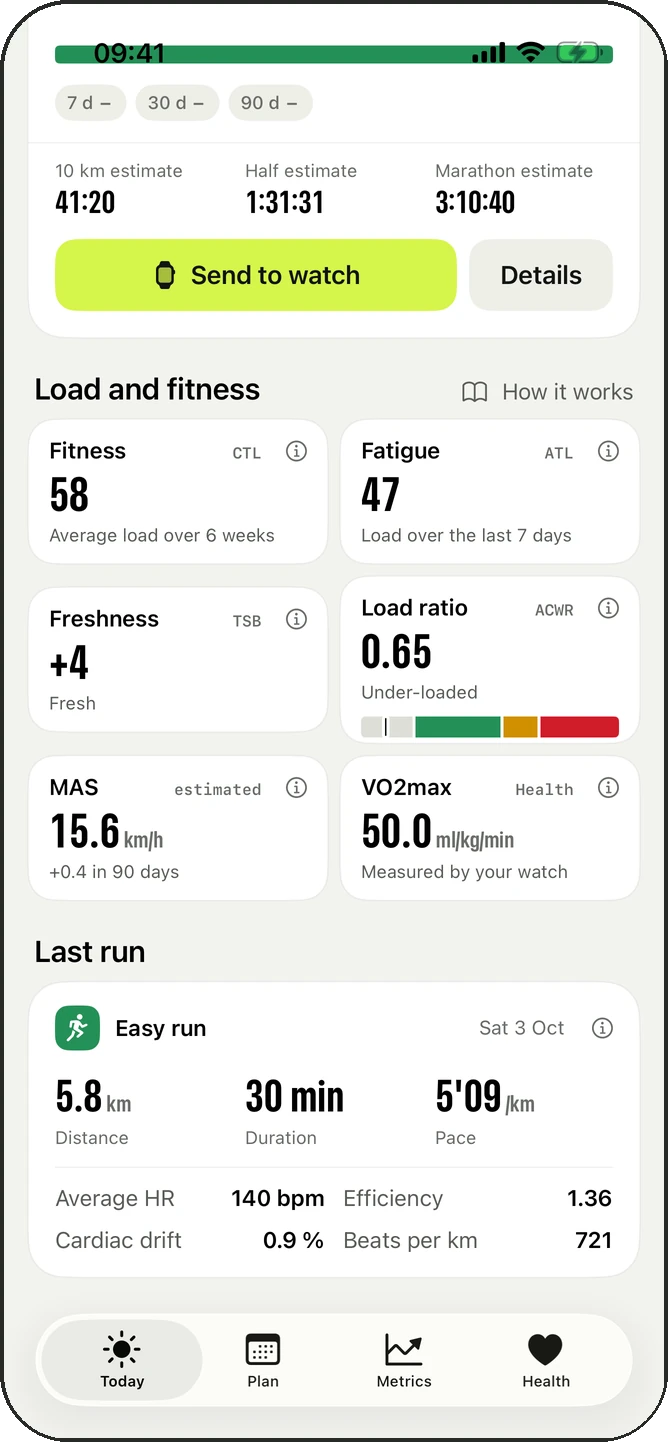
The ACWR (Acute:Chronic Workload Ratio) compares your recent training load with the load your body is used to: is it rising too fast?
02How it’s calculated
ACWR = acute load ÷ chronic load Acute load: 7-day exponential moving average of the daily load.
Chronic load: 28-day exponential moving average.
The load of a session is measured in TRIMP, a number that sums up your internal effort, weighted by heart rate. Runalis only shows the ratio when the chronic load exceeds 25 TRIMP per day: below that (returning to running, beginners), a single run would make the value skyrocket.
03How to read it
| ACWR | Reading | What it means |
|---|---|---|
| < 0.8 | Undertraining | Recent load is lower than usual: fitness may drop. |
| 0.8 – 1.3 | Optimal zone | Recent load is close to your usual: steady progression. |
| 1.3 – 1.5 | Caution | Load is rising fast: a single quality session, volume −15%. |
| > 1.5 | Increased injury risk | Load spike: quality replaced by easy running, volume −30%. |
04What it’s used for
It helps you spot a load spike before it turns into an injury, and ease off for the week when the ratio goes above the optimal zone.
05Limits
The ratio is a statistical indicator, not a diagnosis. It depends on the load measure you choose (TRIMP, duration, perceived effort) and its link with injury is debated in the scientific literature. A high ratio is not an injury; it is a warning sign.
Runalis is not medical advice. If you feel pain, stop and see a health professional.